Saturday, October 28, 2006

Friends, Flights, Food, and Farewells


Saturday, October 15, 2006


Up early and out the door by 7:15. We had a 9:00 am flight to catch that would take us back to Istanbul. Our guide would see us to the airport, and we were all reluctant to part with her. Her spirit was as lovely as her countenance, and we would all miss her, especially Marla. Over the past three days she and Marla had developed quite an attraction. Nearing the airport she turned to me and said that she’d grown quite fond of Marla and our family. We exchanged email addresses and promised to stay in touch, and as as we all unloaded the bus, we hugged one more time, inviting one another to visit our respective homes. I hoped that we would someday get to see her again.

Our flight was booked solid, and security was tight. As we crossed the tarmac and boarded our plane, I was sad to say goodbye to the Western Coast of Turkey, and even more the people I’d met. I never expected to see such marvelous historical sites, or to make friends that would so deeply impact my heart.
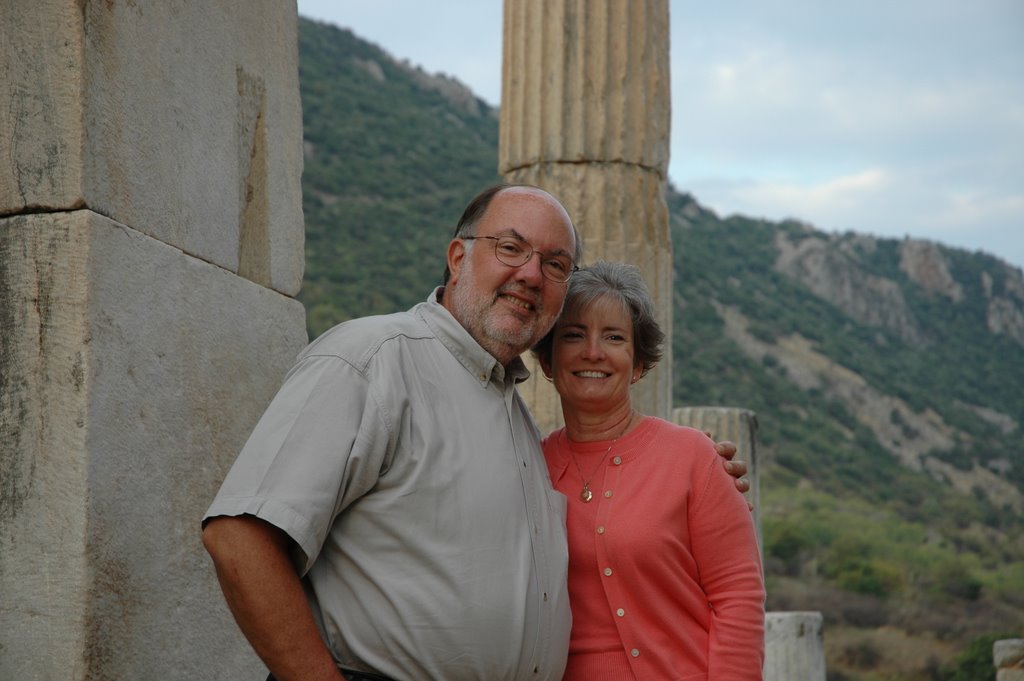

We arrived in Istanbul around 12:30, and then met up with our bus. Joe talked the driver into dropping Don and Lynne at the airport hotel where they would stay the night and then catch a 5:00 am flight to Amsterdam and then to New York. It was sad to say good bye to them even though we knew we’d see them back in Orlando in a few days. Their departure from the group was another sign that our time in Turkey was drawing to an end.

Checking back into the hotel SABA felt a bit sad too. This was our last night here, and none of use wanted to leave this otherworldly place. Don and I talked about the great challenge we would have explaining this incredible trip to others. How could we possibly communicate what the Lord had done in our hearts and lives? How could we adequately describe the things and places we’d seen? Especially, how could we communicate to others our love for brothers and sisters in Christ living in this exotic country? Only one thing was certain in our minds, we wanted to come back.

We all met around 5 to discuss our dinner options. Dan was all for finding a new and cool restaurant, but the rest of us were tired, and weren’t terribly supportive of an adventurous last night… we ended up back at the buffet near the tram stop. One of our contacts met us for dinner and we talked about the work of the Lord in Istanbul. This country, so rich in Christian history, was now 99% Muslim. The church in Turkey needs our prayers and support. As I pushed the last of my food around on my plate, I prayed that the Lord would find us useful for His purposes here.

There was just a little time left to the evening, so Don, Randy, Marla, and I strolled a bit up and down the street. I stopped at a small shop and bought the small round tablecloth that had caught my eye earlier in the week. (I got a GREAT deal!) We wandered back to the hotel, knowing we’d need to pack and prepare for the long trip home.

Hearing someone call my name, I turned to see Mary Beth and Sam coming up behind us. They wanted to say goodbye tonight, as they’d be catching an earlier flight back than the rest of us. We promised to stay in touch and moved on into the hotel.

Bedtime was quick— we were exhausted. I set my phone’s alarm for 6:00 am, and fell into bed. If I fell asleep quickly I might just get 6 hours sleep. My mind was preoccupied with the early flight to New York, and the long hours of flying ahead of us. I could feel sleep beginning to wash over me and could still hear the noise of the crowds from our sidewalk dinner. On our last night in Turkey, I prayed for my friends, prayed for our ministry here, and prayed that the Lord would make a way for us to return.

Thursday, October 26, 2006

Chocolate Smiles From Ephesus


Friday, October 13, 2006

Ephesus, The Basilica of St. John, and the Ephesus Historical Museum

We left the hotel at 7:30 in hope that we might beat the cruise ship tours. Success! Arriving at least 20 minutes before the crowds, we were all eager to see the city that Paul lived in for a few months (Acts 18:19-21) and then on his second visit for about three years. Our guide talked about the history of the city on the bus ride over. Reggie asked some great questions and then shared a bit of the wealth of his knowledge, connecting the dots for us as we thought through what we’ve read in the New Testament about the Church at Ephesus and then tried to bring those thoughts into alignment with what we were seeing.


Ephesus is an old city, even by ancient standards, dating back to 2000 BC. Its harbor surrounded by hills was an ideal port for the ancient shipping trade, and was much prized by conquering invaders. Captured by the Lydians in 560 BC, the Persians in 546 BC, and Alexander the Great in 334 BC, it was the prize of all who traveled its way. The Temple of Artemis, built under the Greek rule, was considered one of the Seven Wonders of the Ancient World. The Goths sacked the city in A.D. 262 and the temple was destroyed.

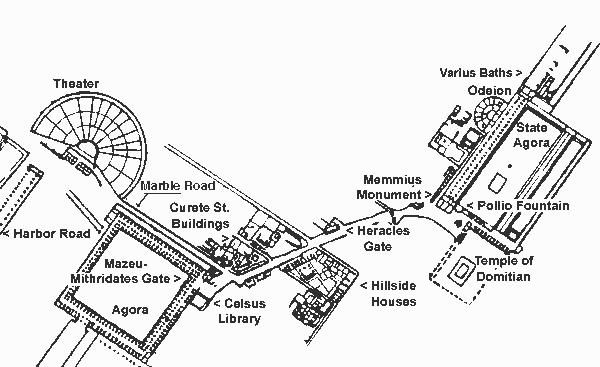
Ephesus was subsequently under the rule of the Roman Empire until 330 AD, when the Byzantines took control of Asia Minor. The city was the seat of a church council The General Council of Ephesus, in 431, and was abandoned in the tenth century when the harbor became filled with silt. Below is a site map for the city.


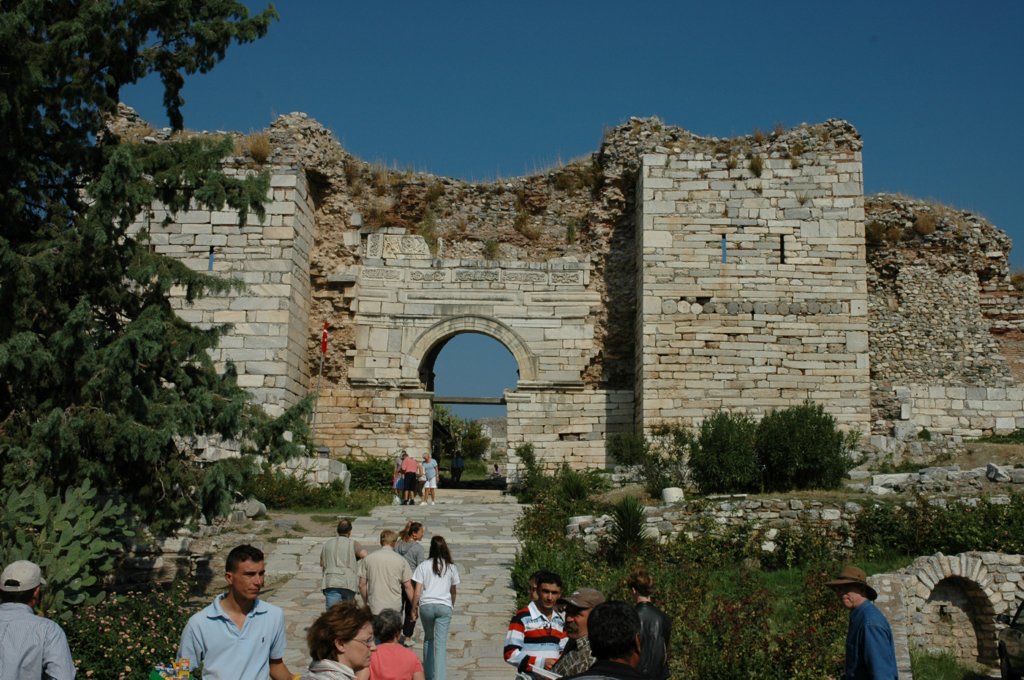
Walking down the main street of Ephesus, we saw ruins of merchant’s shops and public buildings. We paused every few moments to take pictures under arches and to look at the Greek and Roman inscriptions found at the front of some of the buildings. The craftsmanship in the architecture was incredible, and one could easily imagine the beautiful marvel that this city had once been.
One building necessary for any city is the public latrine.


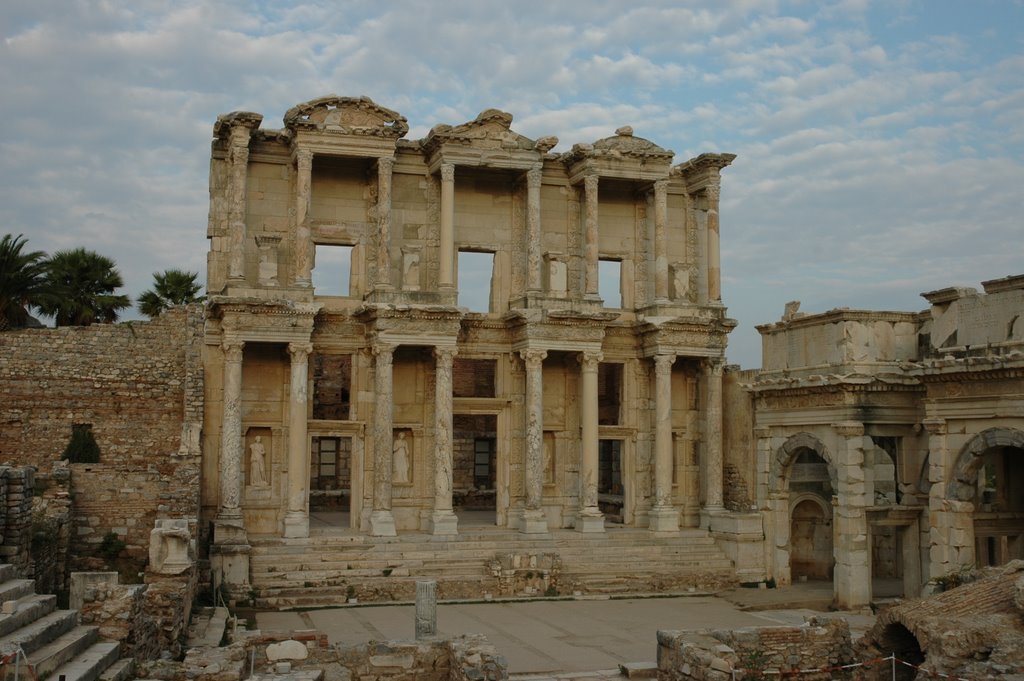
The library at Ephesus was magnificent! The front of the building still stands as a testament to its architect.


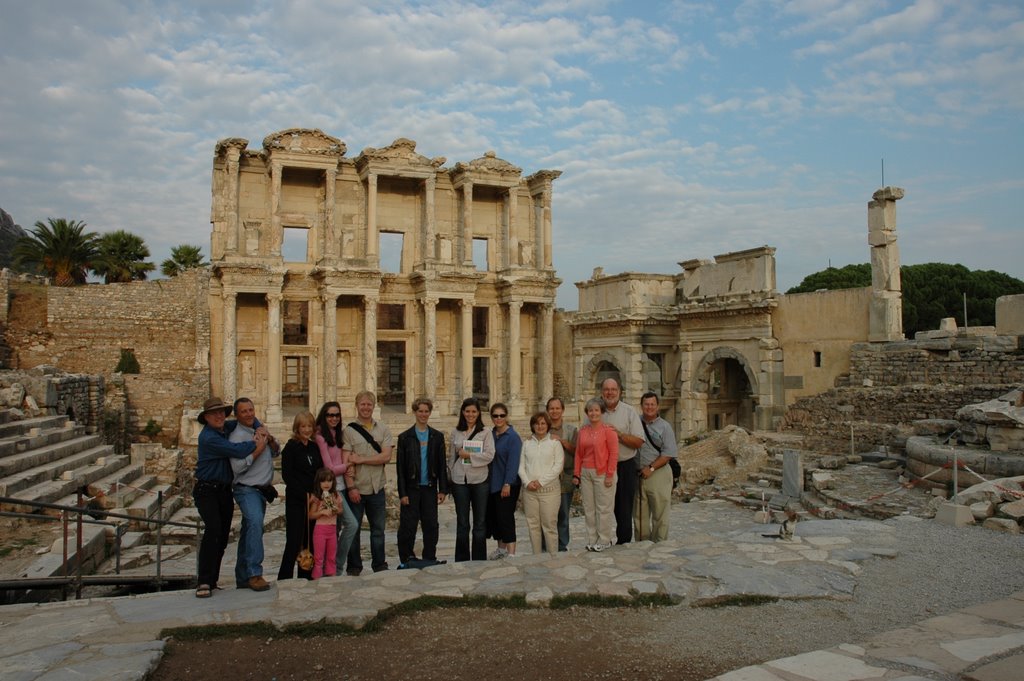
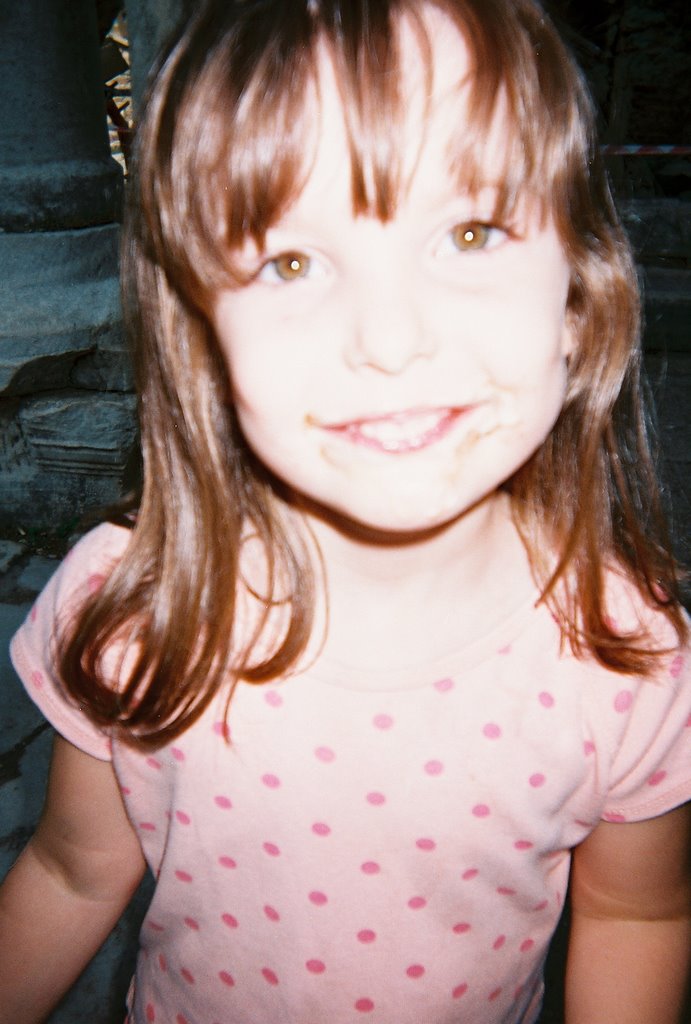
We posed for a group photo on the library steps and took a moment to buy some Magnum Ice cream bars from a vendor. Marla's face was covered in chocolate in a matter of minutes.


Statuary has mostly been removed to museums, but marble carvings like this one of Hermes line the main street.


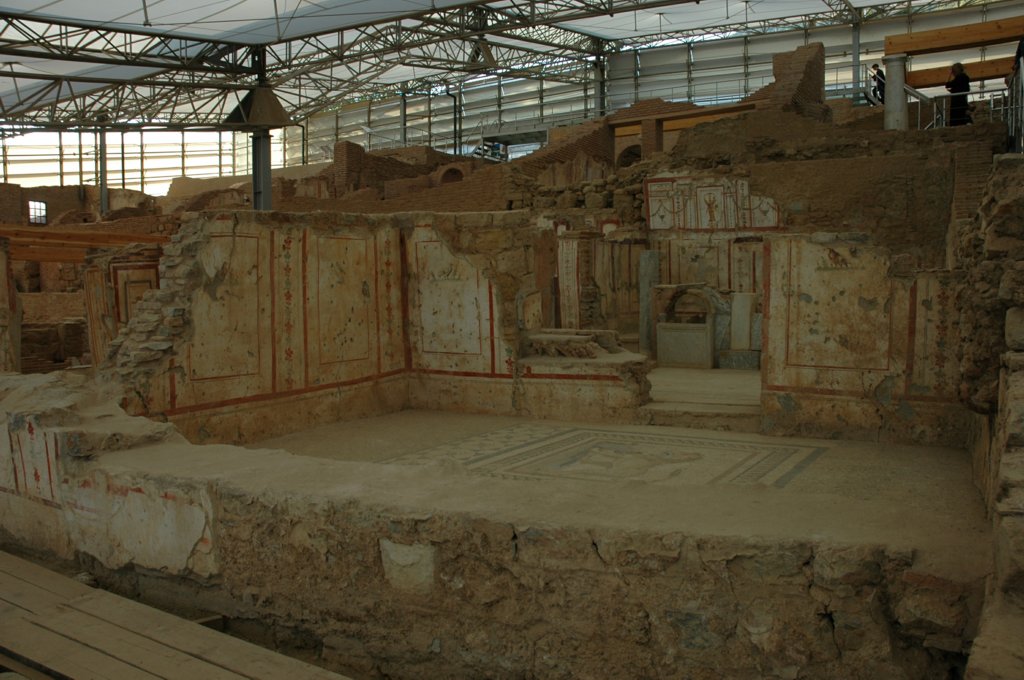
Excavations have been underway on family dwellings that were uncovered on the hillside near the Library.


It has now been determined that the homes uncovered must have belonged to a Priest, as the floors were made of intricately inlaid marble and mosaics, and the walls adorned with frescos, mosaics, and carvings. Archeologists have been reconstructing the living areas and it looks like it must have been quite luxurious.


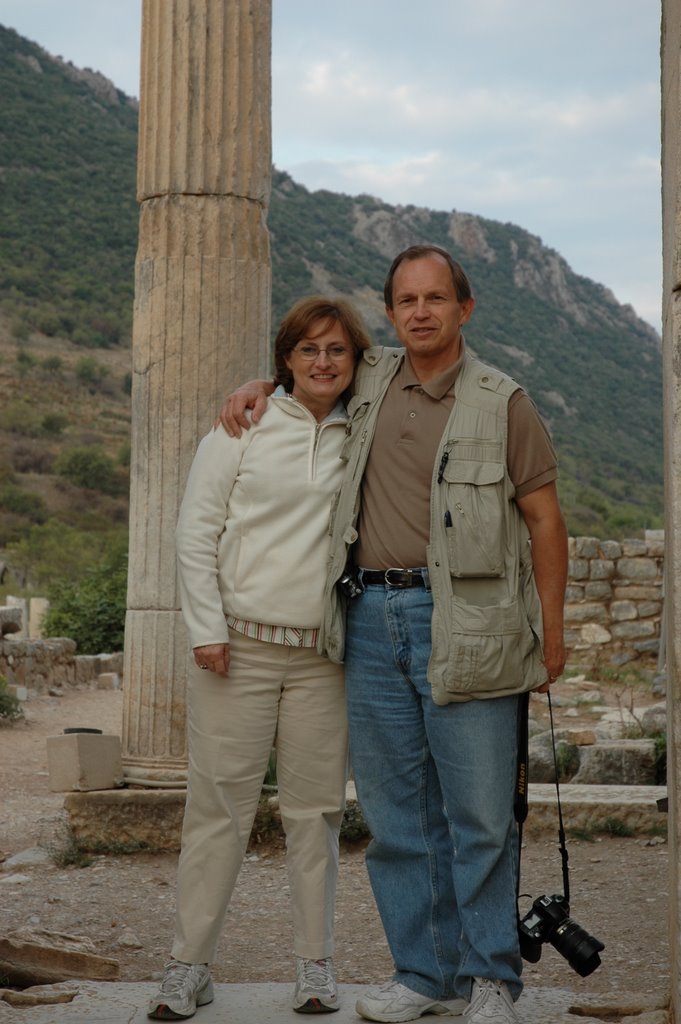
Joe and Rita


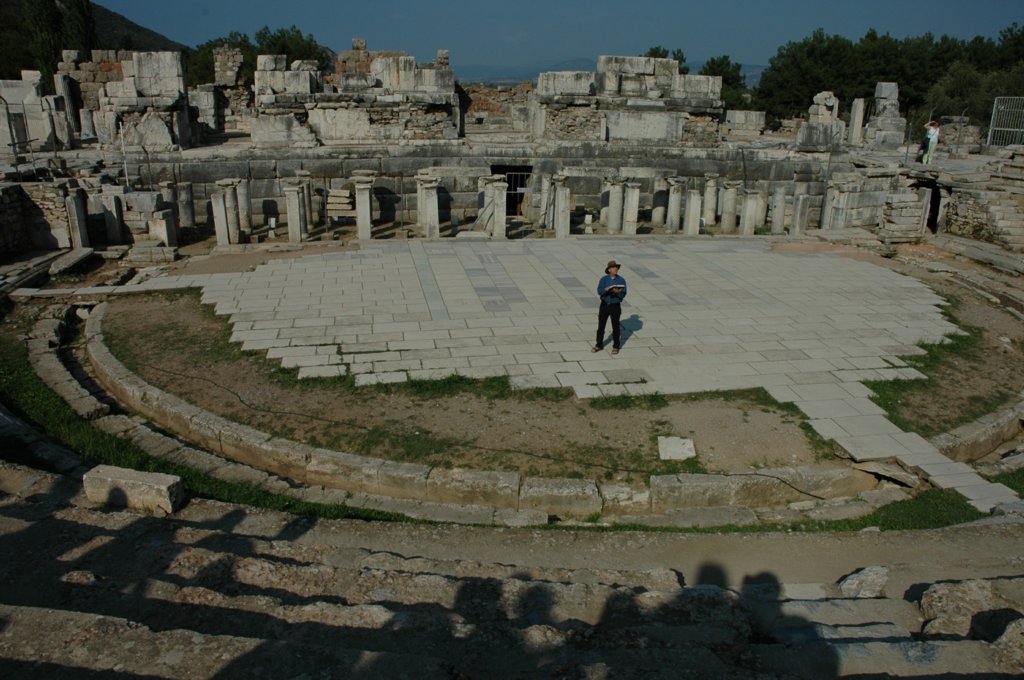
We spent some time in the amphitheater, listening to Reggie read to us from Acts 19:11-41, the account of the silversmiths at Ephesus inciting the crowds to riot against the Christians in their midst.


We then sang a hymn together while we took it all in. The experience was slightly surreal… I could close my eyes and see the crowds. Each of us found it to be one that we would not soon forget.


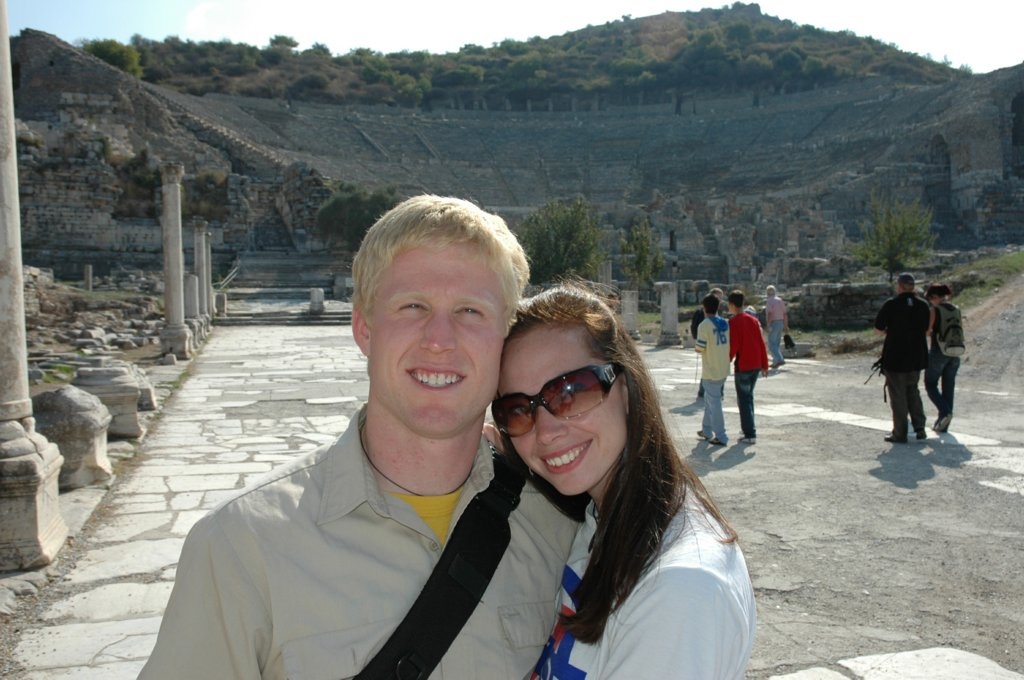
Here's a shot of Sam and Mary Beth just outside the amphitheatre.


These Christian symbols were carved into the paving stones in front of the amphitheater.


Near Ephesus is the Basilica of St. John where the apostle John was believed to have lived the last years of his life and where he was buried. A church was constructed 300 years after his death over the site of is tomb. A basilica was later built under the reign of Justinian, somewhere between 527-565 A.D. The basilica was in the shape of a cross and had 6 domes. Most of the building was destroyed in an earthquake in the 14th century.

One item that was left unmarred was the beautiful cruciform baptismal font in the center of the church floor.


After an outdoor lunch at a restaurant next to a local farmer’s market, we traveled to the Ephesus Museum where many of the priceless artifacts from Ephesus are on display.


Reggie with Diometian, the Roman Emperor who proclaimed himself a god, and also is said to have exiled the apostle John to the Island of Patmos. This statue in its entirity stood in the Temple of Diometian in Ephesus.


The bust of Marcus Aurelius.


Driving back to our hotel, we chatted companionably and talked over the many things we’d seen. We’d walked on some of the same streets as Paul in the past few days and had seen places we’d only been able to imagine prior to this trip. After 9 days of travel, we were all exhausted and exhilarated at the same time. What an amazing journey.


Tomorrow morning we would leave for Istanbul for one last night in this beautiful country. Slipping into sleep, I drifted down a street lined with marble columns, Christian symbols etched into the paving stones, and chocolate smiles from Ephesus.

Wednesday, October 25, 2006

Pergamum, Hieropolis, and Laodicea


Thursday, October 12, 2006

This morning we departed our hotel at 5:00 am, and took an early flight to the Western Coast of Turkey. Our new guide, Ahu, met us at the airport. We quickly boarded a small bus and headed off to the city of Izmir, which was the closest large city to Pergamum. The modern day name of Pergamum is Bergama. The city was founded by the Greeks in the 8th century BC.

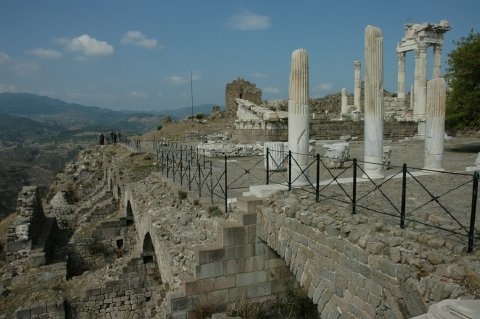
Pergamum sits high on a hill overlooking the valleys beneath. The ruins of the city sprawl across the top of the hill and the temple of Hadrian stands out with it's marble columns. Here is a shot of Marla running around beneath the Temple of Hadrian. None are perfectly intact today due to centuries of earthquake damage and many of it's treasures and statues are missing due to German archeologists taking many of the great artifacts from this area and placing them in German museums in the early 20th century. Turkey is still attempting to negotiate with Germany for the return of ancient artifacts taken.

This is the Temple of Hadrian, which dates back to 117-118 AD.


The city of Pergamum was home to one of the 7 churches written to in the book of Revelation. The angel warned the church to repent, to give up the worship of Balaam, and to not follow the teachings of the Nicolaitans. (The Nicolaitans were teaching that the Priests had special authority over the lay people, and had set up a self-serving hierarchy within the church.)

Nearby stand the ruins of the hospital dedicated to the Greek god Aesclepius, the god of healing. The famous doctor, Galen, worked in Asclepieion (sanatorium) of Pergamum and wrote at least 500 medical books. We walked through the sanatorium and were amazed by the techniques used to treat the mentally ill.

Patients would take a stroll through the tunnel below, which is illuminated by holes cut into the tunnel roof. Water flowed through channels on both sides of the tunnel, frescos decorated the walls, and music would be played. Physicians observed the patients as they passed through the tunnel and then directed them to a sleeping chamber where their dreams would be analyzed upon waking.

Pretty advanced stuff—sounds a good bit like some of the therapy used today.

The hospital also had a theater for the entertainment of the patients which could seat 3,500 people.


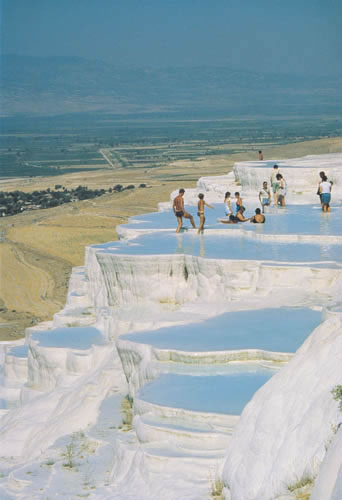
Our next stop would be Pamukkale, (Hieropolis) and Laodicea, the city of Lukewarm faith. Hierapolis was the ancient city on top of the famous hot springs, Pamukkale, in which Cleopatra is reported to have bathed. These hot springs were once rich in minerals, which often had healing properties. The city was destroyed in 17 AD by a major earthquake, and was rebuilt. In 1534 another earthquake destroyed most of the remains of the ancient city.


The pools of water were found on limestone terraces outside the city. Tourists from all over the world were wading and bathing in the pools. A few members of our group tested the water, and said that it wasn’t warm, and wondered aloud if the springs were still truly functioning.


Next stop: Laodicea

Laodicea was once an important city in Turkey, built on a natural trade route. In the Roman period it was the metropolis of Asia. It was a center of banking for the Asian trade route and was famous for it's black cloth, where the weavers used goats’ wool. The wool was a distinctive jet black, the result of the minerals in the water the sheep and goats drank. The water carried to Laodicea came from a hot spring, so that it was lukewarm by the time it reached the city. This adds to the imagery evoked when reading from Revelation in which John says that the city is lukewarm in it's faith.

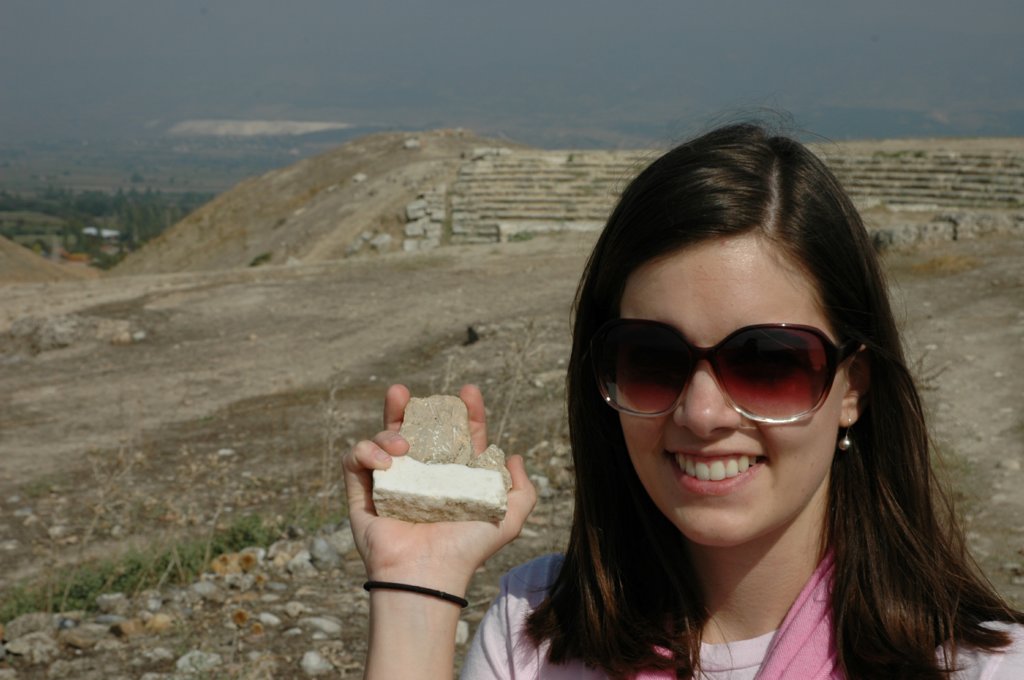
The city has only just been uncovered and archeologists are presently working to excavate and restore artifacts.


Leah has uncovered what she hopes are early building blocks.


The ride to our hotel was a long one—about three hours, in a very cramped bus. Folks took turns riding in the small ledge seat by the door, and I tried to entertain Marla with clapping games and playing I-Spy. By this day she was still traveling well, but was starting to show her fatigue— and so were we!


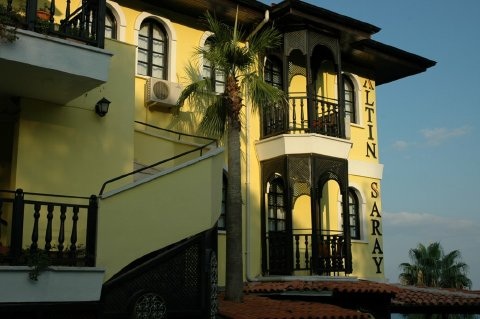
Here’s a shot of the hotel Altin Saray:


Reaching the hotel after dark, we managed to slip into the buffet just before closing time and grab a quick meal. Our hotel was lovely and was situated on a bay near the Aegean Sea. Unfortunately, we never had time to get near the sea—but did see it from afar. The water was the most beautiful color green. The city of Kucadaci is a popular resort town for vacationing Europeans and Asians, with many cruise ships porting there as part of Aegean cruises.

I think we were asleep before our heads hit the pillows... visions of temples, columns, marble walls, golden fields, mountaintops, and limestone pools filled our dreams.

Tuesday, October 24, 2006

Hot Air Balloons to Uchisar

Wednesday, October 11, 2006

Walking where other believers walked over a thousand years ago made us feel somehow connected to them, and passing through the cave homes yesterday had been a rich experience for all of us. After the frantic pace of Istanbul, this ancient land with it’s golden hued landscape was surreal. What could be better?

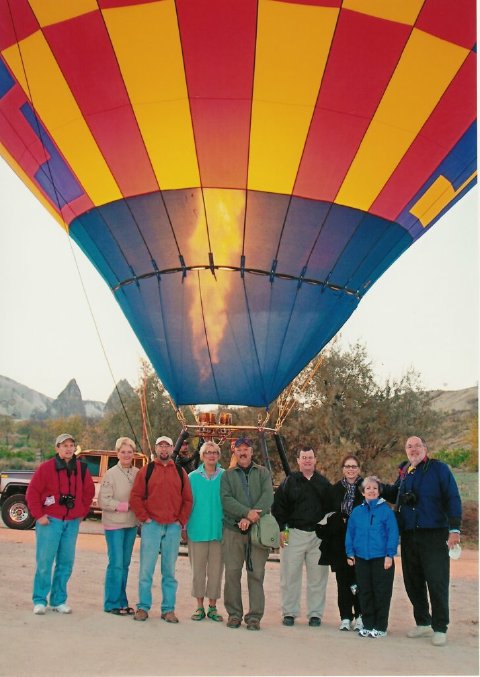
How about a hot-air balloon ride through the canyons, rocks, and hills of this magnificent landscape? Joe, Don B., Lynne, Gina, and Dan got up before dawn to take a sunrise flight.


Joe had made arrangements for anyone in the group who’d like to take one to participate (at their own expense). Every one of them came back saying it was the experience of a lifetime. While in the air, they flew over the city of Uchisar, which for some reason known only to Don B., became the word most commonly used on the bus for the rest of the trip. Every time someone would ask about the next day’s itinerary, or where we should stop for a meal, bathroom, or snack, everyone would shout “Uchisar!” Why? Because it was fun.


They were back at the hotel by 9:00 am, and we set off as a group once again-- this time to see the underground cities that provided refuge for tens of thousands of people during times of invasion and persecution.

A little more Cappadocian trivia: There are about 200 underground cities. Most were built between the 6th and 10th centuries AD. Christians hid in them during the Arab and Persian invasions, as well as the Ottoman invasion. Here you can see a big millstone that had been carved on the spot. The refugees would roll it into place and it would perfectly seal the cave.


We headed up the road to pigeon valley for a scenic photo stop and then to a nearby town for a buffet lunch. The food was delicious—there were some very tasty little meat nuggets that Don and Joe tried to convince me was camel. Sigh.

Afterwards we moved to another valley with Fairy Chimneys that had been used by monks for solitude. The roadside merchants were everywhere, working the tourists and trying to get lots of lira for their wares. The rock formation we stopped to see was called “Camel Rock”.


The sun was setting as we drove back to our hotel for the final night’s stay in Cappadocia. Our hosts were gracious and served us a lovely dinner on the terrace again, depite the fact that they would be arising early with us the next day to see us off with cookies and coffee. The group was really having a great time together and the meal was punctuated with the sound of laughter. What a great day we’d had. Joe announced at dinner that we had to leave the hotel at 5:00 am to catch an early flight to the coast. We’d next be visiting Pergamum, Laodecea, and Ephesus.

Packing up our things, we prepared for a really early morning. We’d spent the past two days walking, climbing, riding, and eating. We’d had no idea this part of our experience would be this grand. Only one thing could have improved it—a stop in Uchisar.

Monday, October 23, 2006

Caves, History, and a Little Moonlight

Tuesday, October 10, 2006

Off to Cappadocia!

Pronounced: Kapadokya in Turkish. The name was given to this part of the country by the Persians, and means “the land of beautiful horses.”


Tuesday

We all rose around 6 am to leave at 6:50 for the airport. Tired but cheerful, we boarded our bus. Flights within the country are very cheap, and the plane was booked solid. Airport security in Turkey is very tight, and we had to go through several security check-points before boarding. I think I must have something metal implanted in my body, because I set the alarms off at every check-point… We landed at Kayseri airport at 10:00 and met our tour guide, Zafir.

A little Cappadocian trivia: This region of Turkey is very arid—rain only falls two months out of the year, and has many small mountains made up of volcanic deposits. The early inhabitants found the mountains easy to tunnel in and made their homes in the caves there. Up until the 1950’s many people in Cappadocia lived in the caves, as a cave home could be purchased for several thousand dollars. They began to move out when electricity and running water became more commonly used, for it wasn’t easy to outfit a cave with the wiring and plumbing. Now, many of the caves have been bought (for quite a bit of money) and turned into hotels.

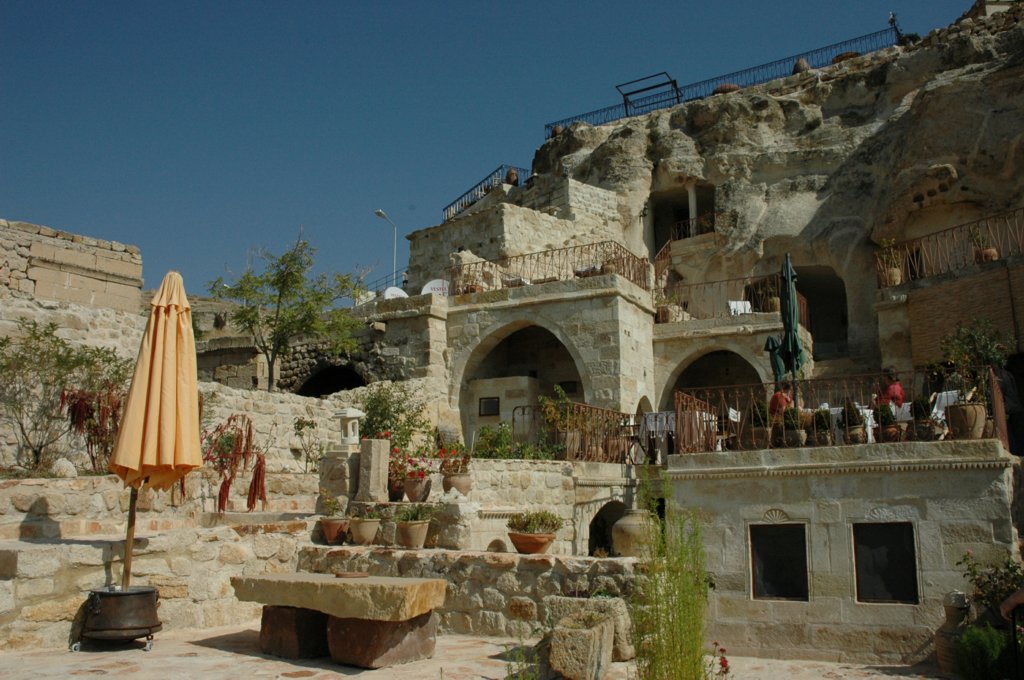
Our first stop was the Kayadam cave hotel, where we quickly stowed our luggage in our rooms. I was expecting something along the lines of the Flintstones, but this place was really lovely.

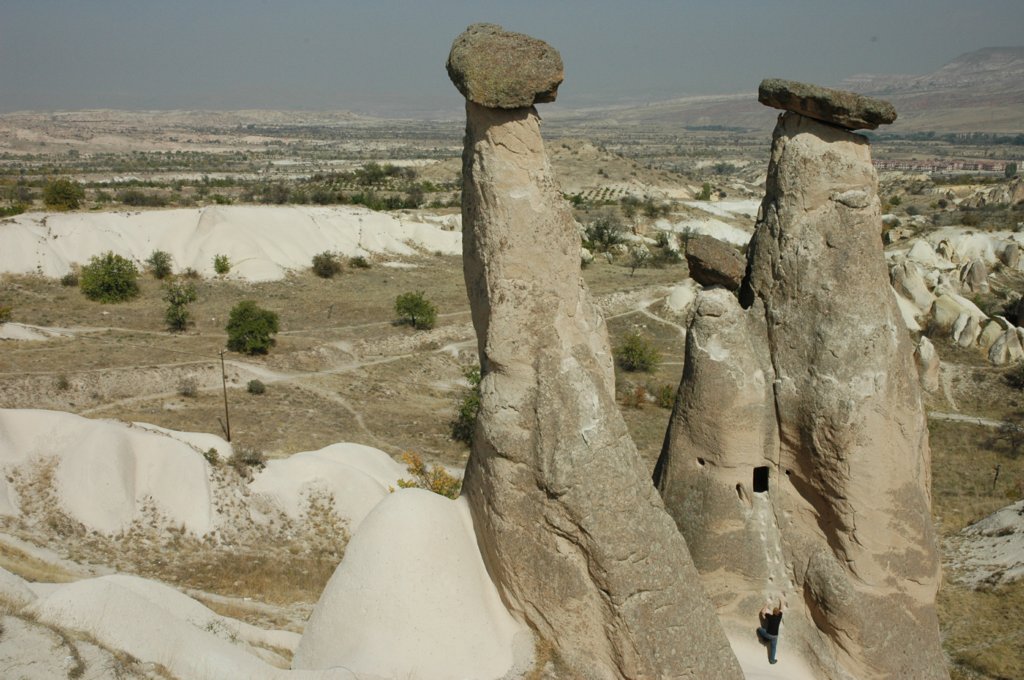
After checking in we loaded back onto the bus and headed out to see the beautiful landscape. Our first destination was the Valley of the Fairy Chimneys. These unusual rock formations were carved by a significant flood at some point in ancient history. What makes them unique is the fact that they’re topped with a “cap” of a different type of rock., and the interior of these formations are often hollow. People used to store their food in them—you can see the opening for a food-storage space in this photo. (Sam, one of the young men in our group, decided to take a personal look.)


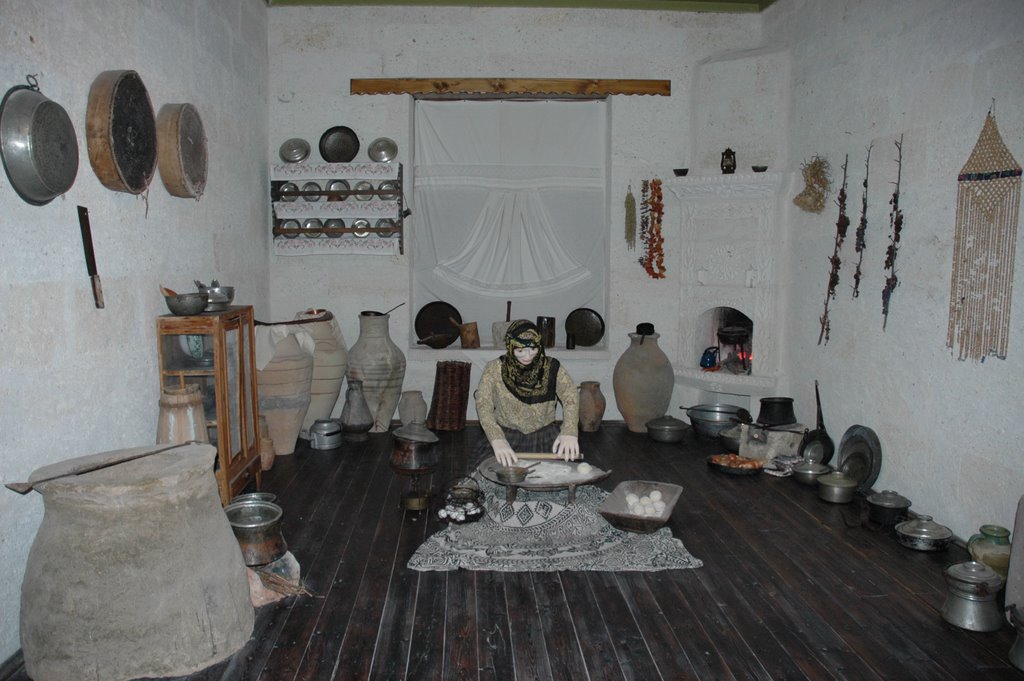
The scenery was beautiful. I kept hearing people say that it was kind of like the Southwest, but not… Zafir wanted to take us to the Cultural Folk Museum so that he could more clearly explain the life of the cave-dwellers. I had a pre-conceived notion of a rather primitive people, but learned that this ancient civilization adapted their surroundings to suit their needs. Pictured below is a re-creation of what a kitchen would have looked like for the Cappedocians.
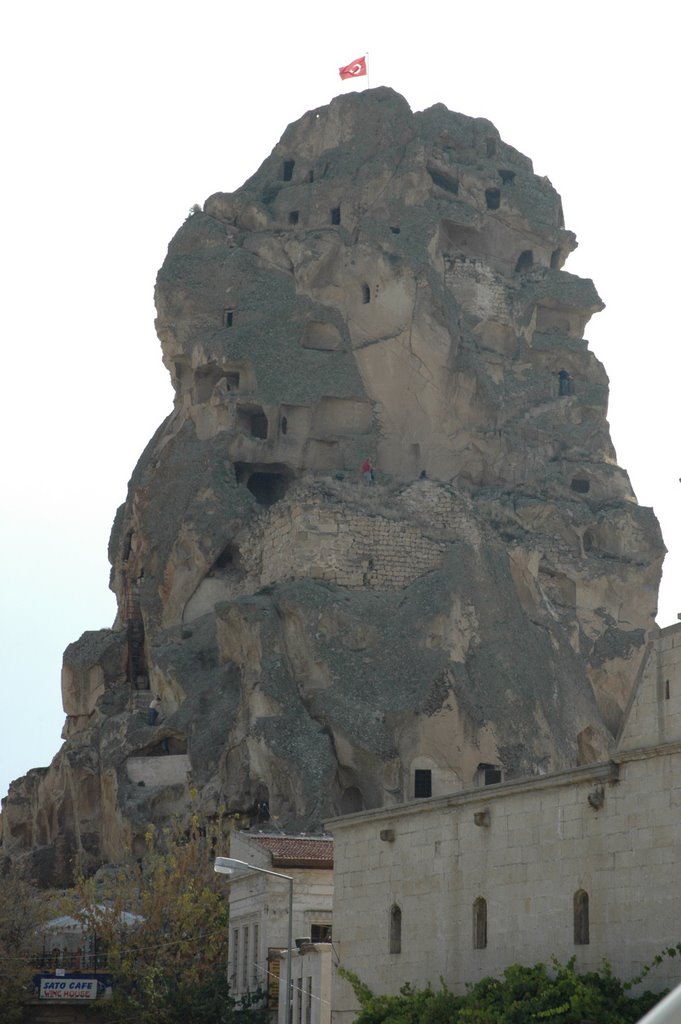
Just after the museum we ate lunch at a lovely terrace restaurant, then took a few minutes to explore the nearby shops while some of our group climbed a huge cave tower nearby. Marla climbed all the way to the top with Don and some of the guys!

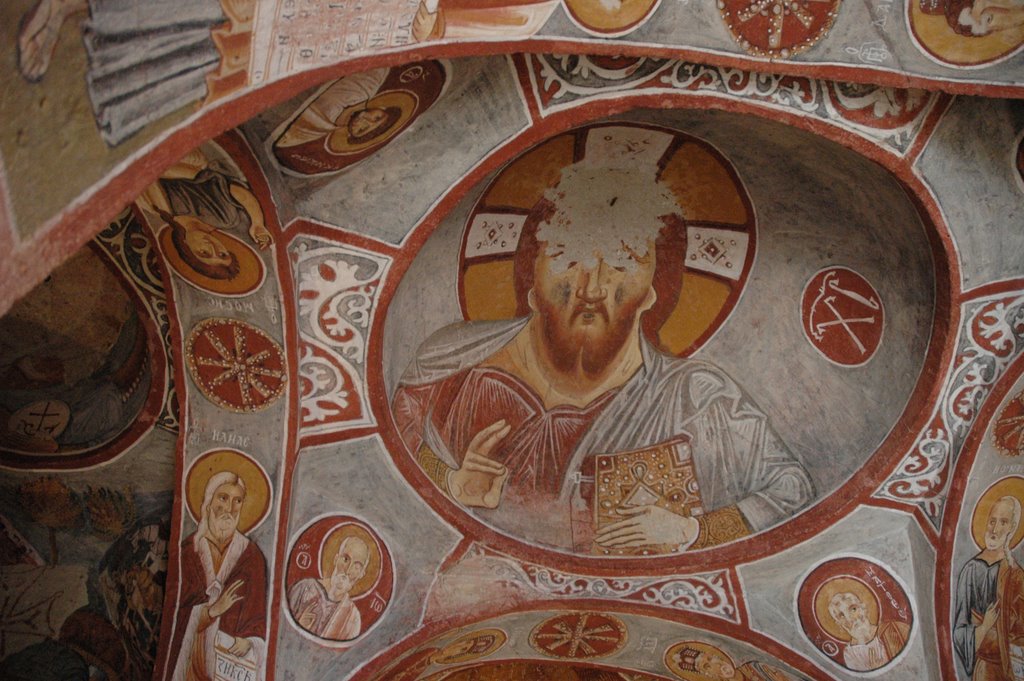
When we’d all reassembled, it was back on the bus and off to see the cave churches. We traveled to a historical site to see the dwellings of early Christians who had carved churches into their homes. It was common for a family to gather privately for worship, and they decorated these chapels with amazing frescos. Pictured below is one of the chapels dedicated to one of the early church Fathers in this area. When the Ottomans invaded Turkey, they would often deface the frescos by scratching out the eyes.


The three fingertips touching represent the Trinity. The colors are primarily reds and golds, as the artists used plants and minerals from the area as their source for color. The three great theologians, Basil the Great, Gregory the Theologian, and Gregory of Nyssa all were born in Cappedocia and returned there in the 4th century AD. Gregory the Theologian, also known as Gregory the Great, brought monasticism to Cappedocia after spending years studying in Alexandria.

It was eerie to walk through this area where these early Christians worked and lived, and to stand quietly in a chapel, knowing that at one time this was truly a house of worship. As we drove back to our hotel, the bus was full of conversation about these people and the lives they must have lived. Tomorrow we would visit the underground cities where the Christians were forced to hide and live when the Ottomans invaded. What must that have been like—to have been forced to a life underground because of their faith?

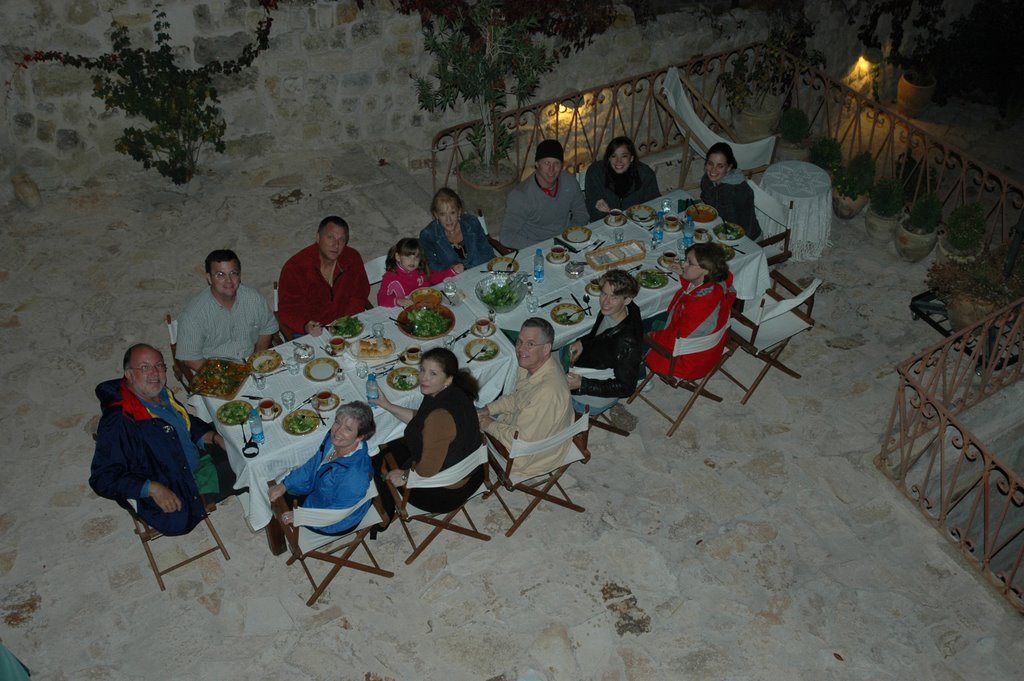
Once back at the hotel we met on the terrace for dinner. The temperature was dropping, and we all had to bundle up. The meal was the best we’d had yet.

Crawling into bed in our cave was a truly novel experience. As we lay there we were stricken with the silence. It was so quiet. A small transom window was set into the slope of our bedroom and moonlight spilled into the cave. Very otherworldly… I could do this-- as long as there was electricity and running water.

Sunday, October 22, 2006

Sisters In Another World

Monday, October 9, 2006

“All my life, all I ever wanted was a sister,” said my new friend in Christ. She waved her hand to gesture around “and look what I have! Sisters in Fort Lauderdale—sisters in Turkey. I never dreamed God would answer my prayers with so many.” I sat amazed. I had never really looked at my friends as my spiritual sisters. I mean, I saw them as kin, maybe—but definitely not sisters. To me, sisterhood carried with it a connotation of closeness and intimacy. I’ve never had a sister— how would I know?

My new Turkish friend was giving praise for the closeness she feels with other women who are believers in Christ. She was telling me, you can be my sister, and I will be yours. As we prayed together for the women’s sessions, in English and in Turkish, I understood what she was talking about.

This was to be the second day of the Women’s sessions—we’d covered suffering and the sovereignty of God in the first session and would move on to what I think is the truly hard stuff, which is the personal pain involved. How does one manage to find faith in a sovereign God, when pain is so excruciating that it seems unbearable? Definitely a heavy topic. I wondered how many women would return for today’s meeting.

We rose at 7 to prepare to travel to the Asian side of Istanbul once again. The men traveled over with us, and would be visiting some sites while we met with the ladies. Marla had been a great traveler so far and she was looking forward to seeing some more of Turkey with her Daddy. She’d made most of the steps we’d taken, but occasionally needed a lift. We got to the meeting place around 10:00 and prepared for the women. We were thrilled to see that most of the women returned.

The teaching session ran for about two hours, and then we broke into small groups for discussion and prayer. This is the time that stands out so strongly in my mind. Pain is universal, and these women had experienced their share. I was so grateful to the other members of our team during the small group time as I listened to them share their wisdom and the comfort of Christ with these dear women from the other side of the world.

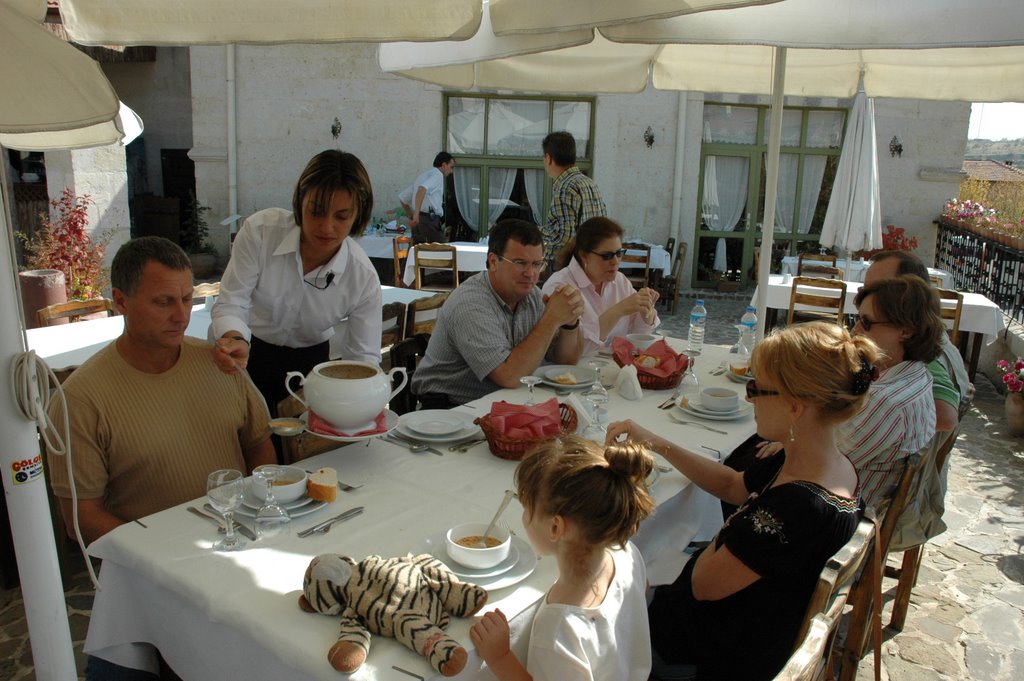
A luncheon had been planned for the women of our team and some of the leaders of the conference at a beautiful restaurant on the Bosporus. We sat on an elegant patio and were served delicious food in a very European setting. It was great to sit and chat, laugh, and puzzle through vocabulary as we ate and reflected on the past two days. A few of the women asked if we could stay a bit longer to possibly counsel with them over issues that had come to the forefront during the sessions. We stayed and talked in this beautiful place for another hour and a half. It was incredibly humbling to be used by the Lord in such a way.

It was nearing 5:00, and we needed to get back across the Bosporus Strait, so we walked back to the Ferries and just missed the one pulling out. About 15 minutes later another pulled in, unloaded, and we were able to board. The ferry ride is really a beautiful thing, if you can overlook the smell of diesel fumes. There’s even a gentleman who goes around with a tray of Çay, for purchase. The best place to sit is on the upper deck of the ferry, where the wind and the view are refreshing.

We docked in Europe at the busiest time of the day, and decided to try the tram system to get back to the hotel rather than walking through the crowds. The men were waiting for us at a local buffet near one of the tram stops, so we ventured forth. The tram was incredibly crowded, and we were quickly separated into groups of two and three.
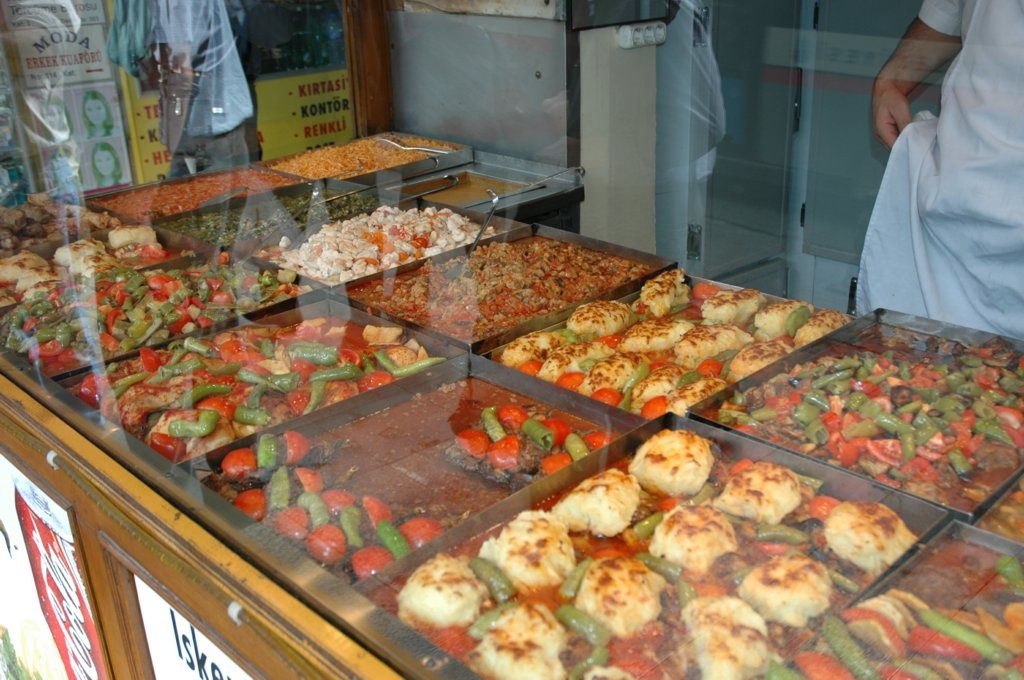
Moving quickly along, we counted stops and got off at the third. The buffet where the men were waiting had outdoor tables set up on the sidewalk. Imagine sitting at dinner, in the midst of what seems like millions of people, horns honking constantly, calls to prayer sounding, and the human noises of traffic and conversation all around you. Our tables were like islands that the sea of humanity parted around in its incessant flow. The food was outstanding, and we quickly decided as a group that we might like to eat there again, if time permitted.

Don had decided to call it an early evening and had stayed at the hotel with Marla, hoping to get her to bed early and catch up on a little sleep. When I got in she was still up coloring, but was ready for bed. It took just a few minutes to get her down and then prepare to join her. Tomorrow would have an early start—we’d be leaving the hotel for the airport at 5:00 am, and would be traveling to Cappadocia. Don and I packed up our things and set our alarms.

Each night when I would lay down to sleep, my head would spin with the images and events of the day. We were experiencing so many things in such a short time and it was beginning to become overwhelming. This night my heart was amazed at the goodness of God in the women’s sessions and in the times of personal dialogue that followed. Culturally, there was a tremendous gulf between us, but personally, we all struggled with the same issues. Once again I was reminded of how Christ connects us to one another, and was humbled to be useful to Him. I walked away from our time with these women with new friends to pray for and sisters in Turkey. This night, when I dreamed of crowds, I also saw the faces of my sisters among them.

Saturday, October 21, 2006

Worship, Yogurt, and Kabobs


Sunday, October 8, 2006

Day 3

Sunday morning we all met in the lobby to start our journey to the other side of Istanbul. I wish I could detail the worship events, but don’t want to jeopardize the work there, so it must suffice to say that we worshipped with others of like faith in at least 4 languages, and it was a humbling experience. Don and I both shared the same feelings about that worship service. We’ll never forget it. The sermon had been printed as a handout in English, so we could follow along. The most amazing thing was that its subject would set up the women’s teaching later that day. Funny how God does that…

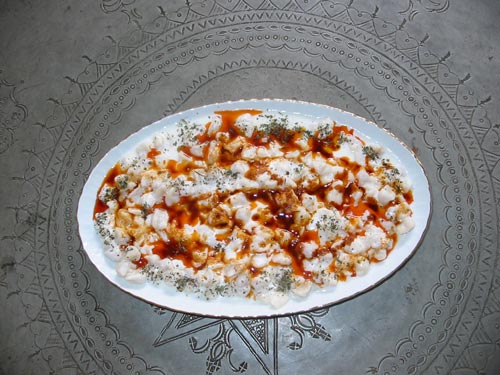
Rita and Gena arrived in time for worship from the airport—it was great to see them there. After the service it was time to grab a quick lunch of dumplings and yogurt (not my favorite combination) and hurry back for the Women’s teaching sessions. The dumplings were a little like tortellini, and had a mysterious little meat in them. The sauce was a tart yogurt sauce with the tiniest bit of garlic in it. The Turks are famous for their yogurt, and I’m sure that if you eat it daily, you might acquire a taste for it, but it was just a little strong for me. I couldn’t help thinking this might be a great place to lose a little weight… After our quick meal we went back to the conference location and taught on Suffering and the Sovereignty of God. There were about 30 women present, and it seemed to go fairly well, although working with an interpreter was really a challenge, and it took a while to get into a good teaching rhythm. The Turkish language is a nomadic language in which words and phrases can have multiple meanings. English is a flowery language with complex grammar rules. We often had to stop and try to rephrase things in a way that would still convey the right idea but be easier to interpret. One of the women attending was a professional interpreter and often jumped in to help clarify statements, and several times another English speaking Turkish woman would jump in too, so it felt like a very cooperative effort. I felt very connected to our interpreter before the day was over.

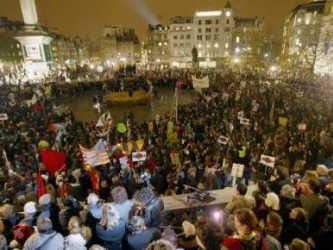
The women were encouraging and promised to be back the next day, and some stayed after to talk with us for a bit about the frustrations and pain in their lives. This was a really sweet time for all of us. We finally headed back for the hotel around 4:30. Once again, we had to walk to and from the ferry, and work our way through the hungry crowds to the hotel. Here is a shot of the crowds breaking fast around the Hippodrome in Istanbul. As you can see, there’s not much room for pedestrian navigation. I found myself trying to say “excuse me” in a Turkish accent repeatedly. (I don’t know why… I guess I thought it was better than just shoving my way through.) The men were waiting on us when we got back. It was great to see their faces when we walked in. The men and Marla had toured that day and she had managed to run into a glass partition with her left cheek—she had quite a bruise, but her spirits were none the worse for wear. She was having a grand time, and proclaimed that she liked Turkey several times that evening.

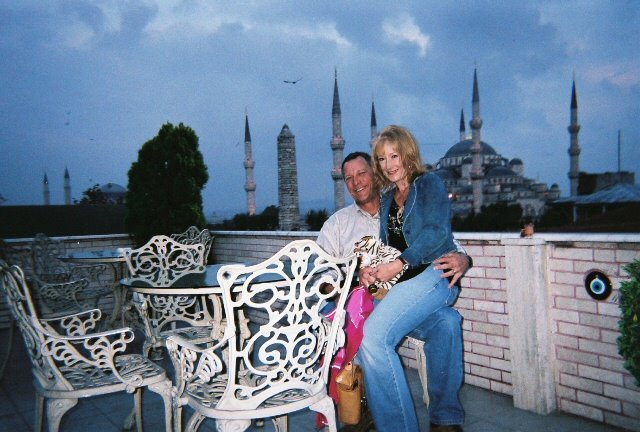
Before dinner, we met on the hotel terrace to reflect on our day as a team. Sitting there in the twilight overlooking the Blue Mosque and the Bosporus was quite magical. Marla snapped this shot of Don and I as we waited for the others to join us. Who would think that a 4 year old would be so good with a camera?


Dinner was the Kabob place again. It was close and convenient, but was losing its appeal. With the city as crowded as it was, it was difficult to find a place that could accommodate our group and be within our budget, so it was Kabobs again, and while we ate, we heard the calls to prayer that would be the last for that day. We ate rather quickly and were anxious to get back to the hotel and to bed. It didn’t take us long at all to get Marla to sleep. We followed her quickly into dreams and slept hard all night. If I dreamed, it was of millions of people crowded together and the smell of kabobs hanging in the air.

Friday, October 20, 2006

Cherry Juice Sellers and Evil Eyes


Saturday, October 7, 2006

This was Day 2 of our trip. (I’m not counting the Flying Day out of Orlando—I’m starting where the real fun began.) The men got up early in the morning, had breakfast on the roof (except for Don—it was tough getting out of the room that morning), and set out for Asia (with Don) to a place where Reggie had been scheduled to teach on the writings of Paul, and to answer questions that we don’t struggle with so much, but to the Turkish men were critical for their view of the Deity and Humanity of Christ. I’m thinking Reggie might blog on this… They would be there until late in the day, so the ladies decided to get in a little sightseeing.

We first went to the Blue Mosque, which was just a few minutes walk from our hotel. The Blue Mosque’s real name is Sultan Ahmet Mosque, and it was built between 1609-1616. Although it’s a functioning mosque, it’s open to the public, so we 5 ladies plus Marla went right in. We had to remove our shoes, and those of us who had necks or arms showing had to put on a blue cotton shawl. On entering the mosque, I was stricken by it’s jewel-like beauty. The entire interior is a robin’s egg blue, and is covered with Islamic calligraphy. Although beautiful, it felt slightly eerie and my spirit was troubled. We only stayed inside for about 8 minutes or so.
We next decided to walk to the Hagia Sofia (pronounced "eye-ya"). We headed across and down the street, crossing a lovely park area. Lynne, Marla, our guide, and I took off with Leah and Mary Beth just behind us. When we arrived at the Hagia Sofia, we realized we’d somehow been separated from Leah and Mary Beth. We were in the main entrance, so we decided to wait there. A few minutes later they appeared, but had a short tale to tell. It seemed that men dressed in festive garb go around selling tart cherry juice to tourists and allowing their pictures to be taken if juice was purchased. Leah had decided to taste the juice and take a picture. How much could it be? When the man asked for her payment, she said she had nothing smaller than 15 liras, and he promptly reached over and took it from her hand. Unable to speak the language, she could only stand there as he went in pursuit of another tourist. Able to speak to us in English, she had much to say about this the rest of the day.

We toured the Hagia Sofia and were amazed at the architecture, art, and historical significance of the building. (See Friday’s blog.) It was wonderful and depressing in the same instance.

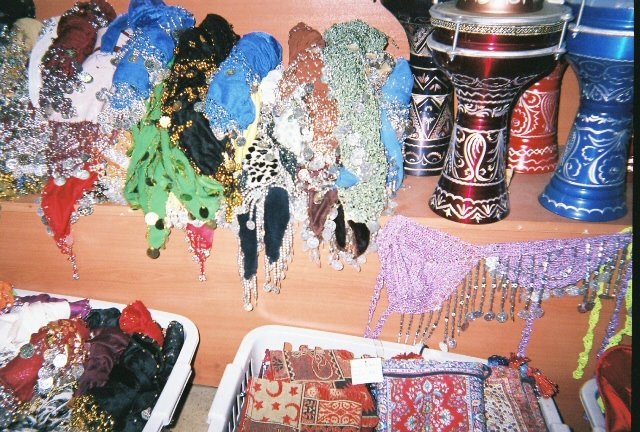
We huddled briefly upon exit. Did everyone want to go to the Grand Bazaar or to another historical site? Grand Bazaar—unanimous decision! Marla took this shot of a merchant's stand in the Grand Bazaar. We quickly learned how to haggle over prices with merchants, and learned the importance of the ‘evil eye’ in their culture. The Turkish people really love children. Everywhere we went, people would comment on Marla and how sweet she was. Shopkeepers would come out of their stores to pin little charms on her meant to protect her from envy and ill-will. These little amulets, called evil-eyes, look like a blue eye painted on a teardrop background. The eye is symbolic of the snake eyes that were featured in Medusa’s deadly hair of snakes in ancient mythology. According to myth, to be gazed upon by one of Medusa’s snakes resulted into one being turned into stone. By the time we left the bazaar, Marla had several pinned to her shirt. Before we left Turkey, she had amassed a small box-full of them.

We had to walk back to the hotel again due to the Ramadan crowds and arrived just ahead of the men. Reggie’s teaching had gone well, and they had lots of stories to tell as we all visited the little Kabob restaurant down the street for a second night’s meal together.

By the time my head hit the pillow that night it was practically spinning. So many people around us all day long, and almost all of them Muslims. We were in the land of the lost, and it was very strange. That night I dreamed of thousands of people milling around, cherry juice sellers, and blue eyed-amulets.